Is Java Still Worth Learning in the AI Era?
- Details
- Written by Nam Ha Minh
- Last Updated on 15 October 2026 | Print Email
It has been part of a bigger aspiration: becoming a professional software engineer, getting a stable job in the technology industry, building large-scale applications, working for well-known companies, and developing a long-term career in software development.
Java has traditionally been one of the languages strongly associated with that path.
You learn the fundamentals. You study object-oriented programming. You move on to Spring, databases, REST APIs, distributed systems, cloud technologies, and eventually become the kind of developer who can build serious production software.
At least, that was the path many of us believed in.
But in the AI era, that path suddenly feels much less certain.
As a Java developer myself, I have recently found myself questioning things that I once took for granted.
AI coding assistants are becoming more capable. AI agents can now generate code, modify projects, write tests, debug problems, and complete increasingly complex development tasks.
At the same time, waves of layoffs in the software industry continue to make developers nervous about job security.And then there is another uncomfortable question:
If one developer equipped with AI can accomplish significantly more work than before, will companies eventually need fewer programmers?
For Java developers, these changes create several painful questions.
- Should I keep investing my time in mastering Java?
- Should I switch to Python because it is more closely associated with AI?
- Will enterprise Java development remain valuable?
- Will junior developers still have enough opportunities to enter the industry?
- Should I continue learning frameworks, APIs, and software architecture when AI can already generate so much code?
- Am I learning skills that will still matter five or ten years from now?
After years of working with Java and sharing Java programming knowledge, I cannot simply pretend that nothing has changed.
The software development industry is going through one of the biggest shifts I have witnessed in my career.And that is exactly why I decided to ask other developers what they think.
I posted the question in the Java community on Reddit and started reading the responses carefully.
Some opinions confirmed my concerns.Others challenged them.
And a few gave me a much more optimistic way to think about the future of Java developers.So if you are experiencing the same uncertainty, worrying about your career, or wondering whether learning Java still makes sense in the AI era, I encourage you to read this article seriously until the end.
I cannot promise a perfect answer.
But the discussion gave me something I was looking for myself: a little light at the end of the tunnel.
And perhaps it can give you some direction too.
1. The uncomfortable reality: AI is changing software development
You learned Java, Python, C++, or another language. You practiced solving programming problems, learned frameworks, built projects, and eventually developed enough experience to work professionally.
Today, that traditional path is being challenged.
Modern AI coding tools can generate Java classes, implement REST APIs, write unit tests, explain complicated code, and suggest fixes for programming errors.
AI agents are taking things even further. Rather than simply suggesting a few lines of code, they can work through multiple development tasks, inspect existing projects, modify files, and execute tests.
Of course, AI-generated code is not always correct. Human developers still need to verify its behavior, security, and suitability for real applications.
But the technology is improving quickly.
What worries me is not that AI will suddenly replace every programmer tomorrow.
It is the possibility that companies may eventually need fewer developers to accomplish the same amount of work.
And this is happening while the software development job market is already under pressure.
For someone considering a career in programming, the uncertainty is understandable.
Why spend years mastering a programming language if AI might eventually handle much of the coding?
I do not have a definitive answer.
And as someone who has invested a significant part of my career in Java, I find that uncertainty difficult to ignore.
2. Java is no longer the most popular programming language
There is another reason I have been thinking about Java's future: its position in programming language popularity rankings.According to the TIOBE Programming Community Index, Java currently ranks behind Python, C, and C++.
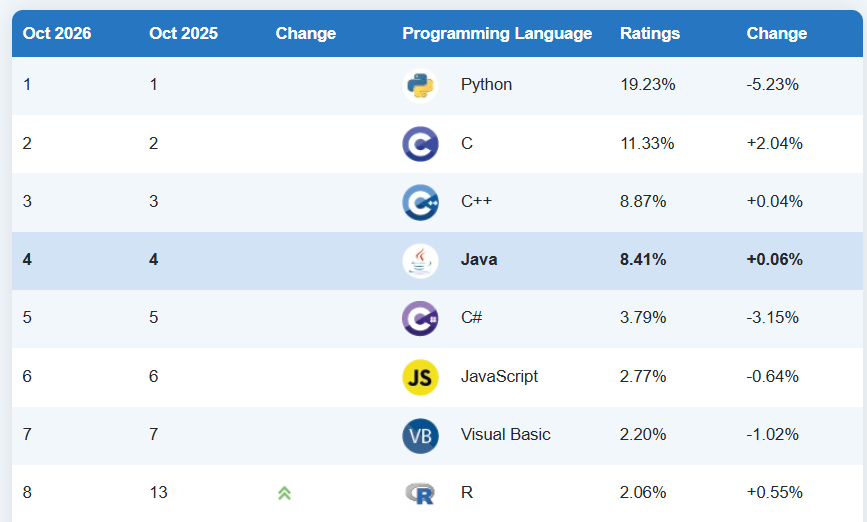
That alone can make the situation feel even more worrying.
Python has become strongly associated with AI, machine learning, automation, and data science. C and C++ continue to dominate important areas such as systems programming, embedded software, and high-performance computing.Java, meanwhile, remains heavily associated with enterprise software and backend development.
That raises another uncomfortable question.
If the industry is moving rapidly toward AI, is Java becoming less relevant?I think we should be careful with that conclusion.
The TIOBE Index measures programming language popularity using search-related indicators. It does not directly measure how many professional developers use a language, how many production systems depend on it, or how many jobs are available.So Java ranking below Python, C, and C++ does not automatically mean that Java is disappearing.
Still, I cannot ignore the trend.
Java once felt like one of the unquestioned centerpieces of professional software development.Today, it feels more like one important language among several major choices.
That does not make Java unimportant.
But it does make me ask harder questions about where Java fits in the future.
3. I asked the Java community on Reddit
Instead of relying entirely on my own assumptions, I decided to ask other developers.I posted a question in the r/learnjava community on Reddit: Is Java still worth learning or pursuing as a career these days?My concern was simple.
If AI continues to improve, programming jobs might decrease. And if the demand for developers goes down, the demand for learning languages like Java could also decrease.
I wanted to hear from people who were learning Java, working with Java professionally, or thinking about the same changes I was seeing.What surprised me was how optimistic many of the responses were.
Instead of telling me to abandon Java and move entirely to Python or AI-related technologies, several developers argued that Java is still valuable, especially for backend development and enterprise systems.More importantly, the discussion reminded me of something that is easy to forget when we focus too much on AI-generated code:Knowing how to write code and knowing how to engineer software are not the same thing.That distinction changed the way I looked at the problem.
4. Three Reddit opinions that made me rethink Java's future
Among the discussion, three opinions stood out to me because they touched on different parts of the same problem: what developers should learn, whether Java itself is outdated, and how AI might affect enterprise Java work.Opinion #1: Java is still worth learning, but Java alone is not enough
One Reddit user gave a very enthusiastic answer: YES.But the rest of the comment made the reality much clearer.
The suggestion was not simply to learn Java.It was to learn Java together with technologies such as Spring Boot, Hibernate, REST APIs, Spring Data JPA, Docker, Kubernetes, cloud platforms, microservices, and even AI-related technologies.
Frontend technologies such as JavaScript, TypeScript, Angular, and React were also mentioned.
This response was both encouraging and intimidating.
It encouraged me because Java was still seen as a valuable foundation.
But it also made me realize how much broader the expectations for developers have become.
Years ago, learning Java well, understanding object-oriented programming, and knowing a few popular frameworks could already put you on a strong career path.Today, that may no longer be enough.
A modern developer is increasingly expected to understand a much larger part of the software stack.
And now AI is becoming part of that stack too.
So perhaps the real question is not: Is Java worth learning?
Maybe the better question is: What should I learn around Java so that Java remains valuable?
That is a very different way of thinking.
Opinion #2: Java is not a legacy language just because many legacy systems use it
Another Reddit response made an important distinction.Java is often associated with old enterprise applications.Because of that, some developers assume Java itself is old-fashioned.
But those are not the same thing.A programming language can have a huge amount of legacy software and still continue to evolve.Java has continued adding modern language and runtime features over the years. Its ecosystem has also evolved significantly, especially around backend development.
The commenter also pointed out that AI is becoming very good at generating repetitive Java code.
CRUD endpoints. DTOs. Mappings. Tests. Boilerplate.I agree. These are exactly the areas where AI tools can save developers a lot of time.But that does not mean AI automatically understands the entire system.
Someone still has to understand the data model.
Someone still has to understand transactions.
Someone still has to reason about security, concurrency, performance, scalability, and the relationships between different services.
And someone still has to understand what the business actually wants.
That made me rethink what it means to be a Java developer.
If my main value is that I can manually type Java syntax faster than someone else, then AI is definitely a threat.
But if my value comes from understanding how a large software system works, how requirements should be translated into architecture, and how technical decisions affect the business, then my role is much broader than writing code.
That distinction matters.
Opinion #3: Enterprise Java systems still need human expertise
Another Reddit opinion was even more optimistic.The argument was that Java's strong presence in enterprise software could actually make it more resilient in the AI era.
Large enterprise applications are usually not simple projects.They often contain years of accumulated business rules, integrations, dependencies, security requirements, and architecture decisions.
Some are connected to banking systems.
Some process payments.
Some handle customer data.
Some integrate with many internal and external services.
These systems cannot be replaced casually.And even when AI can generate code for them, that code still has to be reviewed in the context of the entire system.
That means developers who understand the architecture and business domain can remain very valuable.
I would not interpret this as proof that Java developers are safe from AI disruption.
No programming career is completely protected from change.But the point gave me a more balanced perspective.
AI may reduce the amount of manual coding.It may reduce the need for some repetitive development work.
But complex enterprise software still requires people who understand what the system is doing, why it works that way, and what could go wrong when it changes.
For experienced Java developers, that knowledge may become even more important.
5. What I learned from the Reddit discussion
Beyond those three responses, I noticed several ideas appearing repeatedly throughout the discussion.The first is that Java is still being used in real software systems.Not only old ones.
People are still using Java for backend development, enterprise software, APIs, and large-scale applications.The second idea is that programming fundamentals still matter.
Learning Java can teach important concepts such as object-oriented programming, type systems, concurrency, data structures, exception handling, and software design.
These concepts are transferable.
Even if you later work with another language, the underlying thinking remains useful.The third idea is that AI is changing which programming skills are valuable.
Developers who only know how to reproduce simple code may become easier to replace or may face more competition.
Developers who understand architecture, systems, debugging, business requirements, databases, networking, security, and performance may become more valuable.And finally, the discussion reminded me that nobody can predict the future with certainty.
Some developers are optimistic.
Others are worried.
Some believe AI will reduce programming jobs dramatically.
Others believe AI will mainly increase developer productivity.The truth will probably be more complicated than either extreme.
But reading the discussion helped me stop thinking only in terms of: AI versus programmers.A better question may be: What kind of programmers will still be valuable when AI becomes normal?
That question feels much more useful.
6. Java is still worth learning, but we need to change how we learn it
After reading the discussion, I became more optimistic.I still believe Java is worth learning.
But I do not think we should learn Java in exactly the same way we did ten or fifteen years ago.In the past, much of a programmer's time was spent writing code manually, searching documentation, debugging syntax problems, and implementing repetitive features.
Today, AI can help with many of those tasks.
That means the value of a developer may gradually move away from typing code toward understanding systems and making better decisions.For someone learning Java today, I would still recommend learning the fundamentals carefully.
Learn the language.
Understand object-oriented programming.
Understand collections.
Understand exceptions.
Understand concurrency.
Understand how the JVM works at a basic level.
Learn how databases work.
Learn how HTTP and APIs work.
Learn testing.Then move into frameworks and tools such as Spring Boot, JPA, Docker, cloud platforms, and distributed systems.But there is now one more skill that I think every developer should develop:
Learn how to work with AI, not against it.
Use AI to accelerate repetitive tasks.
Use it to explain unfamiliar code.
Use it to generate starting points.
Use it to help debug.
Use it to explore ideas.
But do not stop understanding what the code does.
The developer who blindly accepts AI-generated code may become less valuable.
The developer who knows how to guide AI, review its output, detect problems, and make strong engineering decisions may become more valuable.
That is a much more optimistic way to look at the future.
7. I need to relearn and adapt, too
Writing this article also forced me to think about my own career.I have spent years working with Java and sharing Java programming knowledge.
Naturally, I have built habits around how I write code, how I solve problems, and how I learn new technologies.But the software development industry is changing too quickly for me to assume that what worked in the past will continue to work forever.
I need to change too.
I need to learn how to use AI coding assistants and AI agents effectively.
I need to understand how AI can be integrated into Java applications.
I need to improve how I think about software architecture and system design.
I need to spend less time doing repetitive work manually and more time thinking about higher-level problems.And perhaps most importantly, I need to accept that being experienced does not mean I can stop learning.
In some ways, I feel like I am becoming a student again.
That is uncomfortable.
But it is also exciting.I already have years of Java knowledge.
Instead of throwing that experience away, I can combine it with new AI tools and new ways of building software.
That may actually be an advantage.
8. Maybe Java and AI are not enemies
At the beginning, I saw AI mainly as a threat to programming. Now I see a different possibility.Java and AI do not necessarily compete with each other.
Java can also be used to build applications that consume AI models and AI services.Enterprise systems can integrate AI features.
Backend applications can use large language models.
Spring-based applications can connect to AI APIs.Existing Java systems can add intelligent search, summarization, question answering, automation, and other AI-powered capabilities.
In that sense, Java developers do not have to watch the AI revolution from the outside.
We can participate in it.
And this may be one of the most important reasons I still believe Java is worth learning.
The future may not be about choosing between: Java or AI.
It may be about learning: Java with AI.
Conclusion: Java is still worth learning in the AI era
When I first asked this question, I was genuinely worried.AI agents are becoming more capable.
Programming jobs are under pressure.
The software industry is changing rapidly.Java no longer dominates programming language rankings the way it once did.
And developers are being asked to learn more technologies than ever before.
All of that can make the future look pessimistic.
I understand that feeling because I have been feeling it myself.
But after reading the Reddit discussion and thinking more deeply about what software engineers actually do, I came to a more optimistic conclusion.Yes, Java is still worth learning in the AI era.
But the definition of a valuable Java developer is changing.
Knowing Java syntax is not enough.
Knowing Spring Boot is not enough.
Knowing how to build another CRUD application may not be enough.We need to understand systems.
We need to understand architecture.
We need to understand business problems.
We need to know how to use AI tools effectively.
And we need to keep adapting.That applies to beginners.
It also applies to experienced developers like me.
I cannot expect the software industry to stay the same just because Java has been part of my career for years.
I have to relearn.
I have to experiment.
I have to adapt.
And perhaps that is the real answer to the question.The future does not belong to developers who know one programming language forever.
It belongs to developers who keep learning while the industry changes around them.So if you are learning Java today, I would not tell you to stop.
I would tell you to learn it seriously.
Learn the fundamentals.
Learn software engineering.
Learn how real systems work.
And learn how to use AI as part of your toolkit.
Because maybe the light at the end of the tunnel is not that AI will leave programmers untouched.
Maybe it is that developers who adapt will become capable of building things that were impossible before.
And that includes Java developers too.Happy coding!
About the Author:
 Nam Ha Minh is certified Java programmer (SCJP and SCWCD). He began programming with Java back in the days of Java 1.4 and has been passionate about it ever since. You can connect with him on Facebook and watch his Java videos on YouTube.