The 80/20 Rule in Programming: 10 Things I’ve Learned from Real Software Projects
- Details
- Written by Nam Ha Minh
- Last Updated on 25 September 2026 | Print Email
The 80/20 rule. Also known as the Pareto Principle, the idea is simple: roughly 80% of the results often come from 20% of the effort, causes, features, or inputs.
Of course, software development does not always divide itself neatly into exactly 80 and 20 percent. Real projects are far too messy for that.
But as a mental model, the 80/20 rule is surprisingly useful. Here are ten observations I have made over the years.
1. You may capture only a fraction of the value you create
One of the first things developers eventually realize is that the amount of value you create for a company can be very different from the amount you are paid.A developer might build a feature that saves a company thousands of hours per year, improves conversion rates, reduces infrastructure costs, or becomes an important part of a commercial product.
Your salary, however, is not directly calculated from that value.
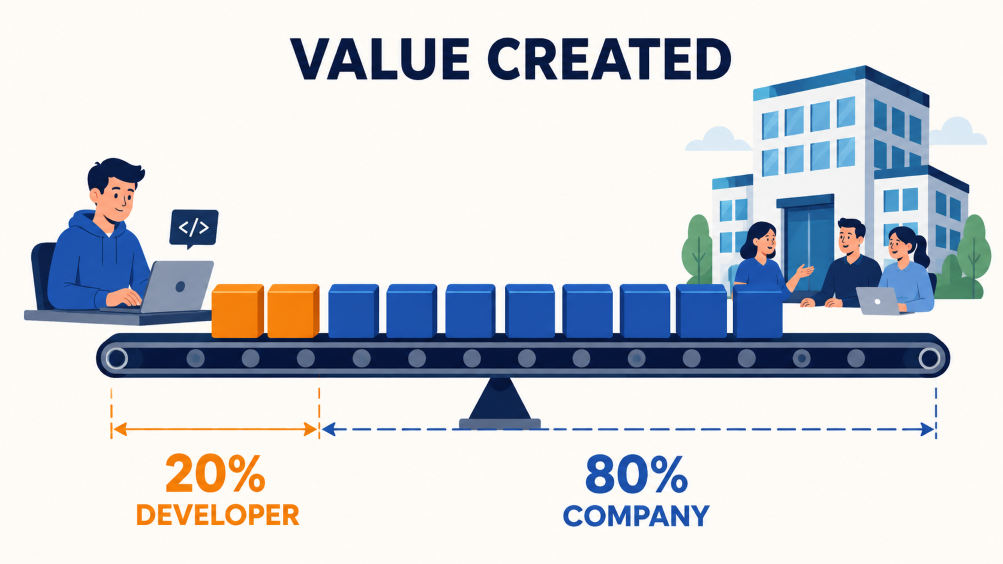 You May Get Paid for Only 20% Of the Value You Create.
That is simply how employment works.
The company takes the financial risk, provides the infrastructure, finds customers, pays salaries, handles sales and marketing, and coordinates the entire organization.
Still, this is an important realization for programmers.
The better you become at understanding business value, the easier it becomes to make better technical decisions and, eventually, negotiate better compensation or build something of your own.
2. You spend much more time reading code than writing it
When I first started programming, I imagined professional software development as hours and hours of writing code.The reality was very different.
 You Spend about 80% of Your Time “Reading Code”
A large percentage of my time has been spent reading.
Reading APIs.
Reading documentation.
Reading source code.
Exploring libraries.
Understanding frameworks.
Reviewing pull requests.
Tracing unfamiliar code written by someone else.
And sometimes trying to understand code I wrote myself six months earlier.
Writing new code is only one part of software development.
This is also one reason AI coding assistants can be useful. Their real value is not limited to generating code. They can also help developers navigate unfamiliar codebases, explain APIs, summarize implementations, and understand existing logic faster.
If tools can reduce the time spent understanding code, developers can spend more time designing and solving problems. Tired of reading long text? I think you will like the punchy video version:
3. You use a small portion of a programming language most of the time
You do not need to know every feature of Java to become productive with Java.The same is true for JavaScript, Python, C#, Go, or almost any other programming language.
In real projects, developers repeatedly use a relatively small collection of concepts: variables, conditions, loops, functions, classes, collections, error handling, I/O, concurrency, and a handful of standard APIs.
Advanced language features matter, but they usually appear much less frequently.
This is why beginners should not wait until they have mastered an entire programming language before building something useful.
Learn the core concepts first. Build real applications.
Then learn more advanced features when a real problem gives you a reason to use them.
That approach is usually much more effective than trying to memorize everything in advance.
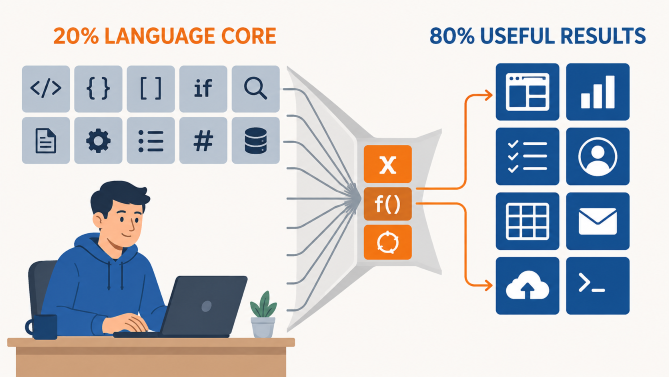 You often use only 20% of a programming language’s features.
4. A small number of developers often produce a large portion of the code
Anyone who has worked on enough development teams has probably noticed this.Some developers simply contribute much more code than others.
They may understand the system better.
They may own important components.
They may be more experienced.
Or they may simply work on parts of the product that require more implementation.
Look through the Git history of a mature project and you will often find that a relatively small number of contributors are responsible for a surprisingly large percentage of the code.
 Around 80% of the code may be written by 20% of the people on the team.
However, lines of code are not the same as value.
A developer who writes less code may still contribute enormously through architecture, testing, debugging, code reviews, mentoring, deployment, security, or product knowledge.
Software development remains a team activity.
The important lesson is not to compete for the highest commit count.
It is to understand where your contribution creates the most value.
5. Most of your application depends on code you did not write
Modern developers rarely build everything from scratch.And they should not.
A typical application depends on operating systems, databases, frameworks, libraries, SDKs, APIs, build tools, package managers, cloud services, and open-source projects.
The actual application-specific code written by your team may represent only a relatively small part of the complete software stack.
Consider a Spring Boot application.
You may write the controllers, services, repositories, and business logic.
But underneath your code are Spring Framework, the JVM, HTTP servers, database drivers, JSON libraries, logging systems, networking libraries, and the operating system itself.
This is why choosing dependencies is such an important engineering skill.
A good library can save months of development.
A bad dependency can create years of maintenance problems.
Experienced developers gradually learn that knowing what not to build is just as valuable as knowing how to build something.
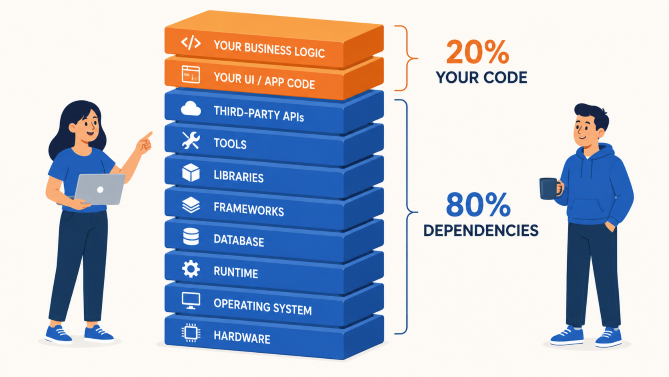 Only about 20% of the code is not written from scratch.
6. A small portion of the code usually causes most performance problems
Premature optimization is one of the easiest ways to waste development time.Not every line of code needs to be fast.
Only about 20% of the code may account for 80% of the execution time.
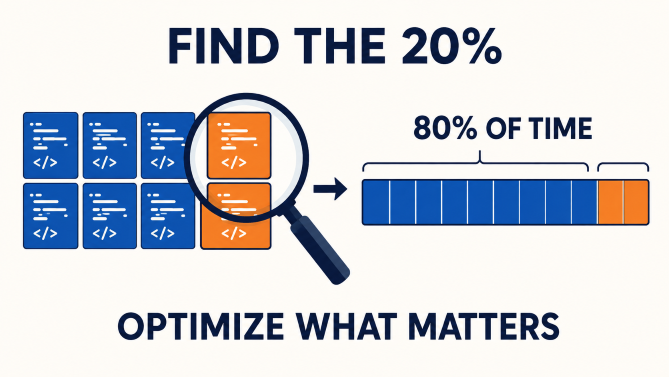
In many applications, only a relatively small part of the system is responsible for most of the execution time.
It might be a database query.
A large loop.
An image-processing operation.
A network request.
A serialization routine.
Or one frequently called method.
That is why serious performance work should begin with measurement.
Profile the application.
Find the hot spots.
Measure database queries.
Inspect memory usage.
Check network latency.
Then optimize the parts that actually matter.
Making an unimportant method 20% faster is meaningless if users are waiting two seconds for a database query somewhere else.
7. Most software bugs tend to come from a surprisingly small part of the codebase
One thing I have noticed repeatedly in real projects is that bugs are rarely distributed evenly across the entire codebase.Some modules are almost boringly stable.
You may not touch them for months, and they continue to work exactly as expected.
Other modules seem to attract bugs again and again.
You fix one issue, release the update, and a few weeks later another bug appears in the same area.
This often happens in code that deals with complicated business rules, many edge cases, external systems, concurrency, state management, or frequently changing requirements.

Around 80% of software bugs may come from just 20% of the code.In other words, a relatively small percentage of the codebase can generate a disproportionately large percentage of the bug reports.
That is a very different problem from performance optimization.
With performance, you are asking:
"Which code consumes most of the CPU time, memory, or network resources?"
With bugs, the question is:
"Which parts of the system keep failing?"
That distinction matters.
A piece of code can be extremely fast and still be full of bugs.
Likewise, some slow code may be completely reliable.
Over time, bug-tracking systems often reveal clear patterns. The same modules, components, or workflows appear repeatedly in issue reports.
When that happens, simply fixing each individual bug may not be enough.
You should start looking for the deeper cause.
Maybe the code is too complicated.
Maybe responsibilities are mixed together.
Maybe requirements are unclear.
Maybe the module has insufficient test coverage.
Maybe too many developers keep changing the same piece of code.
Or perhaps the original design no longer matches how the application is being used today.
This is where the 80/20 rule becomes especially useful for software quality.
Instead of treating every bug as an isolated accident, look for clusters.
If 80% of your production bugs are coming from 20% of the codebase, that 20% deserves special attention.
It may need better automated tests.
It may need stronger validation.
It may need clearer logging and monitoring.
And sometimes, it simply needs to be redesigned.
The goal is not only to fix bugs faster.
The goal is to stop the same part of the system from continuously creating new ones.
8. Users rely heavily on a small number of features
Developers like building features.Users usually care about completing tasks.
Those are not always the same thing.
A large application may contain dozens or hundreds of features, but many users repeatedly depend on only a small subset of them.

Users may spend 80% of their time using only 20% of your app's features.
Think about the software you use every day.
How many features in your IDE do you actually use?
How many options in your operating system settings?
How many functions in your favorite productivity application?
Probably not that many.
This has an important product lesson.
More features do not automatically make better software.
Sometimes improving the speed, simplicity, reliability, and usability of five important features produces more value than adding another twenty rarely used ones.
Quality often beats quantity.
9. Software schedules are usually more uncertain than they appear
Estimating software projects is difficult.A task that appears simple can reveal an unexpected dependency.
A library can behave differently than expected.
An API can be poorly documented.
Requirements can change.
A production environment can expose problems that never appeared during development.
This is why many software projects exceed their original schedule or budget.
From the developer's perspective, this means deadlines should be treated seriously, but estimates should not be confused with certainty.
From the project manager's perspective, the lesson is even more important.
A beautiful Gantt chart does not guarantee progress.
Real progress has to be measured continuously.
What has actually been completed?
What remains uncertain?
What dependencies are blocking the team?
What technical risks have appeared?
Good software management is less about predicting the future perfectly and more about detecting reality early.

Many software project plans eventually go off schedule or over budget.
10. AI may write most of the code, but developers will still own the result
This is the most interesting version of the 80/20 rule today: up to 80% of the code may be written by AI.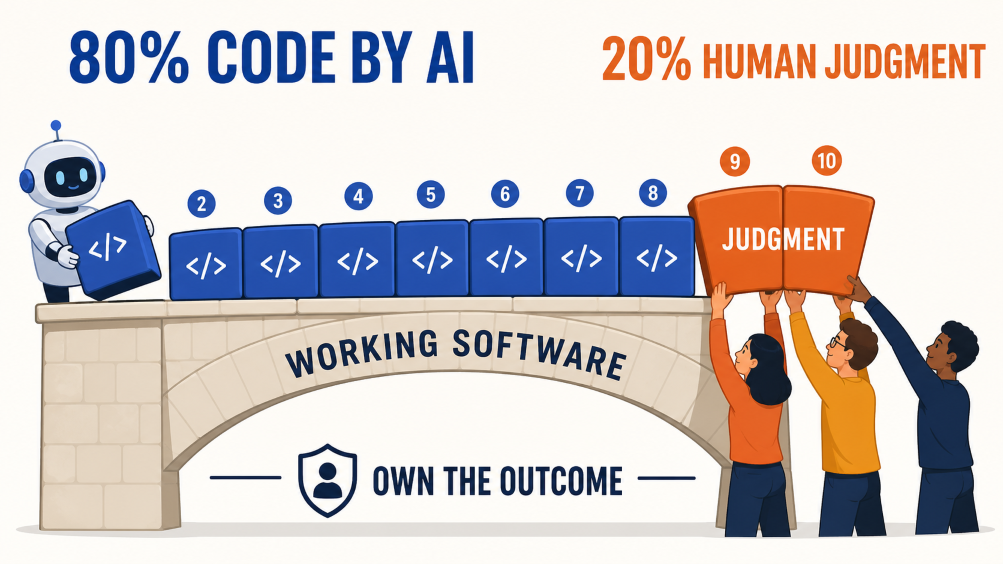
AI coding tools are becoming increasingly capable of generating implementations, tests, documentation, configuration files, SQL queries, scripts, and even large portions of applications.
It is entirely possible that developers will eventually type only a small percentage of the code in many projects.
But that does not necessarily mean the developer becomes less important.
The job may simply move to a different level.
Someone still has to understand the problem.
Someone has to choose the architecture.
Someone has to decide whether the generated code is correct.
Someone has to recognize security problems.
Someone has to determine whether the database design makes sense.
Someone has to debug the system when the AI-generated implementation fails in production.
And someone has to take responsibility for the final result.
In other words, the valuable 20% of human work may increasingly consist of judgment rather than typing.
That could include:
• understanding requirements
• designing architecture
• selecting technologies
• reviewing generated code
• validating assumptions
• debugging difficult problems
• understanding security and performance
• making trade-offs
• communicating with stakeholders
AI may dramatically change how software is produced.
But software engineering has never been only about producing code.The real lesson of the 80/20 rule
The most useful lesson from the Pareto Principle is not the exact percentages.
It is the idea of unequal importance.
Not every line of code matters equally.
Not every feature matters equally.
Not every bug matters equally.
Not every optimization matters equally.
Not every programming language feature matters equally.
And not every hour of work produces the same amount of value.
The more experienced I become as a developer, the more I try to identify the important minority.
Which 20% of this code creates most of the risk?
Which 20% of the features deliver most of the value?
Which 20% of the APIs do I actually need to understand?
Which 20% of the performance problems are affecting users?
Which 20% of the work should I focus on first?
That, to me, is where the 80/20 rule becomes genuinely useful in software development.
It is not a mathematical law.
It is a reminder to focus engineering effort where it matters most.
About the Author:
 Nam Ha Minh is certified Java programmer (SCJP and SCWCD). He began programming with Java back in the days of Java 1.4 and has been passionate about it ever since. You can connect with him on Facebook and watch his Java videos on YouTube.
Comments